- Pictures with Words
- Posts
- Same Track, Different Conditions, Different Bike
Same Track, Different Conditions, Different Bike
Memorial Day, The Dry Day
Scott Clayton
June 10, 2024
Monday, Memorial Day, was foretasted to be a dry day, and it was. Remember last week’s newsletter was about the day before, Sunday, the wet day. Oh boy! My legs were sore Monday morning. I used the message gun in between each of the sessions, morning to early afternoon.
Mark Price was at the track days! An awesome instructor, by the way. Since I was a student of his, twice last year. He asked me what I was working on for that day. I said, “I want to get the front tire to talk to me.” (While on the brakes) Which is slang for, I want the front tire to give me an indication that it’s starting to approach the limit of grip. This relates to item number four on my March 18th newsletter: https://scotts-newsletter-c35485.beehiiv.com/p/im-working. Man plans, God laughs. It was my eyes that I ended up working on.
Since it was dry that day, everyone was out on track. The speed difference between the ZX6RR (about 110 hp) and the R1 with a kit ECU (about 190 hp) is massive. Being tense and having sore legs wears you out quickly. It was my eyes that were causing the tense-ness. I could see just fine, but I was looking at reference points too long. It was like target fixation on a reference point, then jumping to the next one. There was no fluidity because I wasn’t scanning back and forth. I wasn’t looking to where I wanted to go, and back to where I was. Like when you were first learning to drive, you probably looked just ahead of the hood. I think it was the speed difference between the bikes, my eyes were used to the slower pace of the ZX6RR; this caused me to be tense. As my scanning adjusted to the new pace, and using my outside thigh to also help lean the bike, this allowed me to relax.
Scanning is the key to going faster, I think. The faster you can scan, the faster you can go.

Monday morning, warming up the SC3’s with tire warmers.
I was on a new set of tires I’ve never tried before. I wanted some SC3-Slicks from my Pirelli guy (Chris at https://www.ctracetires.com/), but he only had SC3-Track Day tires, a tire that could be used on the street and the track. Same compound of rubber as the Slick tire. Slicks require tire warmers, track day tires only recommend them. SC3 is Pirelli’s hardest compound. SC1 being on the softer side. And SCX being the softest. I wanted the SC3 for the cooler Seattle Memorial Day weekend, and for the June event. SC2’s and softer, are pure racing slicks. I used SC2 the last half of last season and am planning on using SC2’s for the hotter events later this season.

Pirelli’s Compound Chart
This was also the first day of riding the R1 with Yamaha’s Genuine Yamaha Technology Racing (GYTR) kit ECU. It definitely has more power, which I turned down; in some areas. So why do I need more power if I’m just going to turn it down? Because you can make it act like a ZX6RR (low horsepower) in the corners and a rocket-ship down the straight-ways. I turned down the power in first and second gear. Gears used for, leaned over in the corners. And turned up the power in fourth through sixth. Gears used for straight up and down riding on the straightaways. I am planning on turning down the power even more for the corners, until I find a point where it’s too low, then, turn it up to just right. I can hear the risk oriented persons (mothers, of any type) say, “Why don’t you do the exact opposite?” Set the power on lowest then turn it up. Because even if the power is too high, I can give it less throttle input. I am trying to find a point where I can use full throttle and not want to have any more power. This argument is actually invalid, because it works for either direction. But turning it down is the direction I started with.
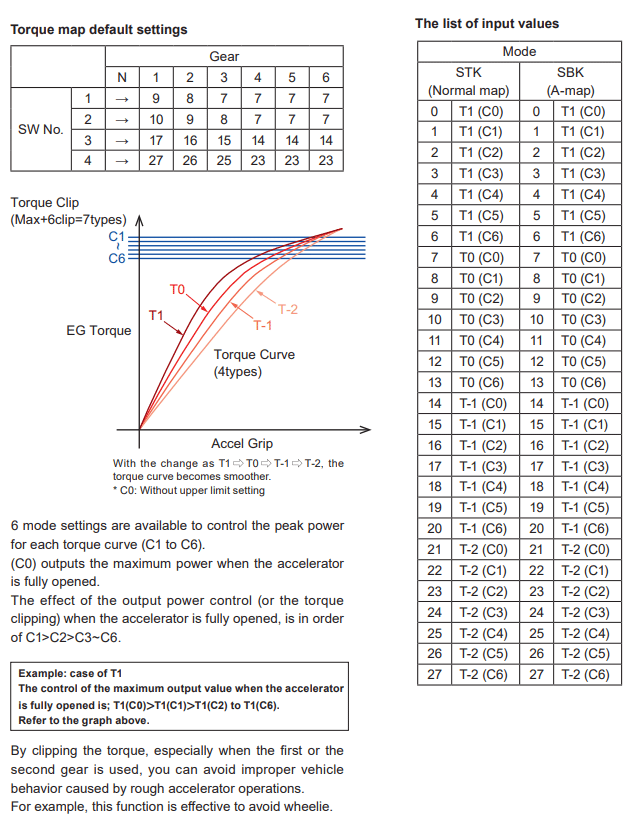
Yamaha’s power menu.
Yamaha truly doesn’t want you to use the kit ECU on the streets. With the kit ECU, you need the kit wiring harness. Most of the connectors are the same, but the wiring and pin-outs are different. This makes Yamaha’s lawyers happy, I’m assuming. Because there are no connectors on the kit ECU wire harness for: turn signals, horn, lights, brake light and the radiators. It seems to me that you would still want the radiators used for the club racers and track day guys. I have not removed the radiators because I’m still in search of a device that can plug into the radiators that has power and a thermostat. Yamaha does sell a sub-harness with switches that connect to the lights and brake light for endurance racing. However, the brake light is controlled by an On/Off switch, not the brake lever. The ABS unit is required to be connected to the kit harness, but the ABS does not function. Yamaha also sells a dummy plug which makes the kit ECU think the ABS unit is connected.

Same buttons, new functions on Yamaha’s kit ECU.
You cannot plug the kit harness into your key-ignition. They give you a pigtail plug, to turn it off, you remove the pigtail and hopefully don’t lose it. Or you can buy Yamaha’s GYTR On/Off switch, which leaves you with a key that now only works for the gas cap. Just like the pigtail, it’s something that could easily be left at home when you are at the track. So Yamaha sells a GYTR keyless gas cap. These are all the things I learned installing the GYTR ECU and harness.
Even with all this encouragement to only ride your R1 on the track. Yamaha also added something that would make street riders very angry. On the latest kit ECUs Yamaha has programmed a HUGE hesitation between the 3,000 and 4,000 rpms. On the streets, you use that range of rpms all the time. If you are in that range on the track. You are in the wrong gear! Leaving the pits and entering hot pit lane, I use the clutch to slip past this hesitation range of rpms.
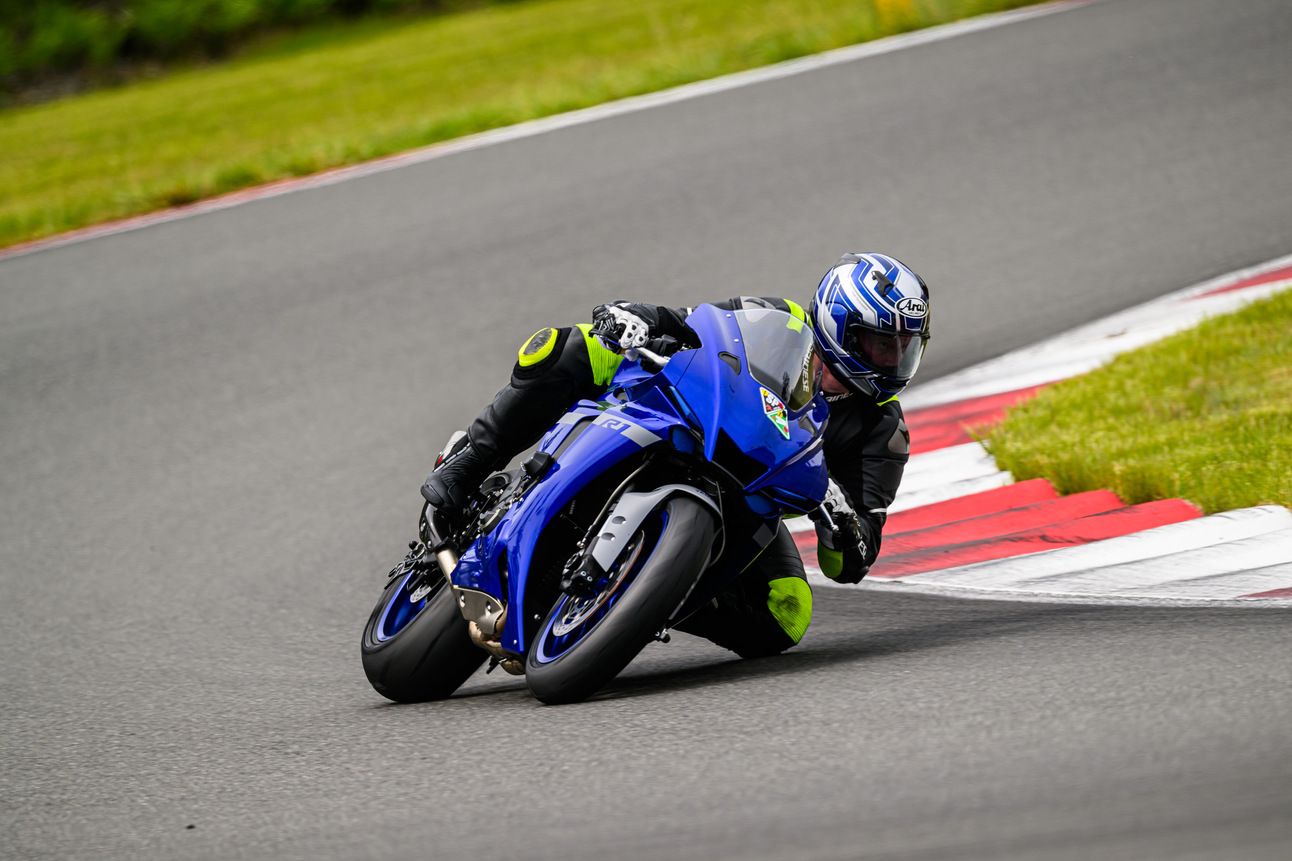
Look at that relaxed inside elbow! At least compared to last year. Where did that come from? I haven’t ridden on track in eight months!
I think it came from visualization during the off-season. This is like virtual on-bike training. I imagined/visualized getting my upper body lower on the motorcycle, in my desire to be on track during the off season. More weight off to the inside allows the bike to be more up-right. Look at the other rider in the photo below. Maybe this rider doesn’t always ride this. But in this photo, his upper body is more on top of the motorcycle, not so much off to the inside. Notice the angle of his inside elbow compared to mine. Also notice this rider’s front tire lean angle compared to mine. I am not better than this rider. I am just pointing out something, I believe to be, a correlation. His body position looks like mine of last year. You can tell how tense someone’s inside arm is, by the angle of their elbow. Remember Ryan Hughes, from the March 18th, 2024 newsletter? Are you a thinker or a feeler? https://scotts-newsletter-c35485.beehiiv.com/p/im-working
I am trying to be a feeler.
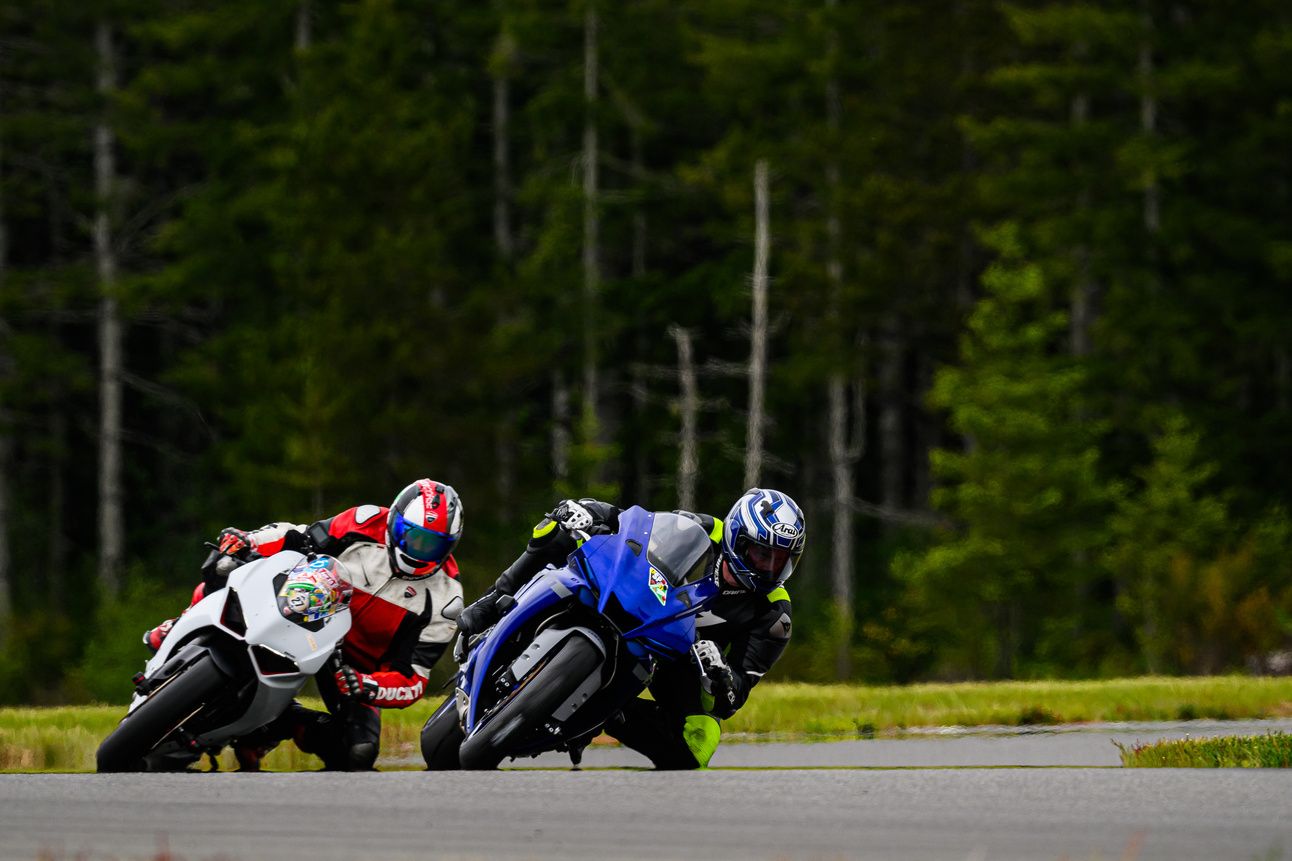
I gave those two track days, my all. On the way home I was glad to go home. I didn’t want to ride the next day, even if I had the opportunity. I needed time to recover, analyze and debrief. I’ve always thought it was crazy how some professional racers talk excitedly about having some time away from the bike. But when you give it your 100%, now I see it. I wasn’t pushing the limits of grip, but I was giving everything I had to getting up to speed. This is also a recipe for burnout. That’s not the objective. It’s to have fun! Freddie Spencer says, let the speed come to you. What he means is, don’t chase after it.
Reply