- Pictures with Words
- Posts
- What I'm Working On
What I'm Working On
A To Do List For 2024
Scott Clayton
March 18, 2024
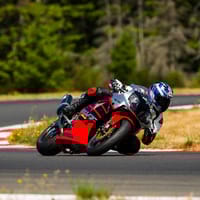
When I started doing track days consistently, meaning more than one or two a year. I had a focus on improving by learning technique, not just rolling the dice and spinning laps. But going down the technique route wasn't fun at first. I remember loved ones saying, you don’t look like you are having fun. They were right, I wasn’t having fun. I spent all this time and money, to not have fun. But I knew I could get better and the image of me being better (in my head) looked like fun. And that’s just the way it has turned out. I am having fun and there is even more fun to come.
I love Ryan Hughes’ philosophy on riding. Here is one of my favorites: If your arms are tense, you’re a thinker. If your arms are loose, you’re a feeler. I am definitely a thinker. And that needs to change. He says champions are feelers, such as Ricky Carmichael (motocross), Michael Schumacher (F1), and Valentino Rossi (MotoGP). Thinkers aren’t in the present moment, because they’re thinking about what’s coming up ahead, or how they performed in the corner behind them. One of my struggles on track is having a tense inside arm. This locks up the steering head on track. When I relax my inside arm, the bike turns so much easier. But that is only half of it, having loose arms allows you to feel what the tires are telling you. I need to pull back the pace a bit, allowing myself to relax (loose arms) and be in the present moment. Thinking is always future or past, never present, as Ryan Hughes says. Check out this awesome Gypsy Tales Podcast with Ryan Hughes:
This one’s hard to explain, but easy to see inside my head. First, I’ll explain how I’m doing it wrong. Maybe that will help you understand how it’s done correctly. But even before that, you need to understand that turning with the brakes applied, allows you to turn your vehicle (car or bike) in less time and distance. For example, this is something you can try in your car, in an empty parking lot. Going at a slow speed, hold your steering wheel in a fixed position so your car is making circles. If you speed up, your circles get bigger, if you let off the gas, they get smaller. If you put on the brakes, your circles get even smaller than letting off the gas. Remember drawing circles in school with a compass? The pointy end pokes a hole in the paper (center of the circle) and the pencil draws the circle’s circumference. The distance between the pointy end and the pencil is the radius. The smaller the radius, the smaller the circle. Increasing the amount of brake pressure will decrease the radius of your circle. Traction is the limiting factor. Imagine doing this in the snow! So what I’m doing wrong, on large radius turns is, I have used the brakes correctly. I have used the brakes to get my bike to rotate, but once the radius of my bike’s turning matches the radius of the corner, I’m still ever so slightly on the brakes. Not enough to rotate the bike any more, I’m just scrubbing off speed, for no reason. What I should be doing is applying a tiny-tiny bit of throttle (but not enough to increase the radius) when the bike’s rotation matches the radius of the corner. This will allow me to open up the throttle when I see my exit, instead of transitioning from the brake to the throttle when I see my exit.
In the future there will be an integration (of technique) between the paragraph above and the paragraph below, that I am still trying to work out.
Well. Writing the last paragraph just opened my eyes to a solution to the problem I had planned to talk about in this paragraph. Freddie Spencer Exits. A Freddie Spencer exit is something Ken Hill and Nick Ienatsch rarely talk about. And I think I know why. If you see it as a lesser known competitive advantage, or a very advanced technique, I think you’ll know why too. Bike, car, vehicle, it all works the same. If you can get your bike to rotate more, just before you accelerate out of the corner. You’ll need to apply a committed, larger amount of throttle to actually keep your vehicle from running off the inside of the track. And hit your apex. More throttle equals lower lap times! So what Freddie is doing, is putting the bike on a slightly smaller circle, than the circle of the corner he’s on, just before he has to accelerate out of the corner. And then apply enough throttle to keep the bike from running off the inside of the track. The problem I see with this is, it’s 100% commitment. If you decide to give up, you’re probably running off the inside of the track, or experience a drastic and aggressive standing up of the bike or centering of the steering wheel. I see a Freddie Spencer Exit as something you would first try on a very long radius 180 degree corner (think large half circle), where you have more time to see, take action and adjust if necessary. Once you have this concept down, maybe bailing out (if needed) and centering your vehicle isn’t as bad as I imagine. That’s what Ken Hill said to me.
More brake pressure on turn in. This is SO EASY to do in a car, where you have two extra wheels to catch you. On a motorcycle that you don’t want to crash and a body that you don’t want to hurt, it’s another world. I have been working on this, for what feels like forever. And I have a long way to go. I have felt the front tire of my dirt bike tuck (slide) and my natural reaction is to release the brake lever, so the front tire re-grips. And it did, and I have only experienced this a couple of times. But a dirt bike weighs half as much as a sportbike and the speeds are vastly lower than on a racetrack. So this is why I have been working on this for a long time and will be working on this for a long time. No one silver bullet, just millions of small copper BB’s.
Edited, March 16th, 2025. For an updated, read March 17, 2025’s Newsletter.
Reply