- Pictures with Words
- Posts
- Scanning.
Scanning.
The keys to speed.
Scott Clayton
December 23, 2024

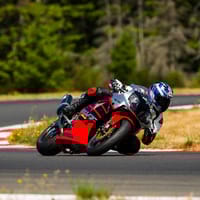
This newsletter needs some pictures, so here’s one of my favorites. Nothing exciting to see, I’m turning in for turn 4, at The Ridge. However, the photography is pure genius! The lighting, the shadows, the hills in the background with the bike and rider at the crest of a hill on track. The colors of the curbing match the colors of the bike/rider. Photo by Ryan at threesixtyphotography.com
I remember Ken Hill telling me, “When you go to the brakes, look at the slow point.” There is a lot of knowledge and assumptions that need to be explained in that statement. Starting with the assumptions first. Even though I was still young in my learning of the knowledge based part of track riding, which can also be applied to the street. He knew (correctly assumed) that I knew the basics of track riding fundamentals and the glossary of terms that he and others like him are trying to establish in this sport.
I will explain the knowledge part of that statement. It’s a great way for me to remember, revisit, and keep sharp on the knowledge based part of riding. And for you, you’ll get to learn, if not already known. If known, you can sharpen my knowledge even further by critiquing my work.
To streamline this, riding and driving are the same. Lean angle and steering angle are the same. The concepts work the same, whether you are riding a motorcycle or driving a car, truck, limousine, or dump truck.
You look at the slow point (short for: Slowest Part of the Corner) because it expands your depth perception. What is the Slowest Point of the Corner? Ken’s exact words are, “The end of the deceleration zone, the end of your direction change, and the start of the acceleration zone. The Slowest Point of the Corner varies based on corner radius.” Let me break this down further. By “…deceleration zone…” he refers to two types. Braking, by using the brakes or engine braking, by using the compression of the engine with a closed throttle to slow down the bike. “…the end of your direction change…” this one took some time for me to understand. You are at the end of your direction change when you are not leaning the bike over any farther. It was a steering wheel that made it easier for me to understand. When you have the steering wheel turned as far as you are going to turn it for a given corner, meaning you won’t turn it any farther. This is the end of your direction change. You may hold it here for a long time, such as a cloverleaf while entering and exiting freeways. Or you may hold it there for a split second, such as turning into a parking lot. The “…start of the acceleration zone…” is pretty easy to understand. Unlike deceleration, there is only one form, rolling on the gas/throttle/accelerator. And “…The Slowest Point of the Corner varies based on corner radius.” was already explained in the cloverleaf vs. parking lot example. Cloverleaf, having a large corner radius (long slow point). And turning into a parking lot, which has a small corner radius (short slow point).
Now that I’ve broken it down, let’s build it back up. The slowest part of the corner is the part where you are done turning the steering wheel, and you are done braking. These are not sequenced, one end does not come before another. The end of deceleration and turning-in happen at the same time. Now the car is leaning and all the groceries have slid to the other side. You are not going to turn-in any more and you are off the brakes. Since the tires are doing almost everything they can to turn the car, you are about to very gently roll on the gas/throttle/accelerator. This is the slowest point of the corner. You are not going to go any slower and you are not going to go any faster. Hence, the slowest point of the corner.
Looking at the slow point expands your depth perception when you go to the brakes. This implies some other fundamentals are already known. One, you are scanning, looking at reference points for a split second. The faster you can scan, the faster you can go. And two, you are braking in a straight line, no turning. There are two missing reference points that are also implied. You can’t have depth perception unless you look (scan) back to where you are (one reference point) and where you want to turn-in (the other reference point). So in total there are three. Slow point (1), where you are (2) and the turn-in point (3). Then repeat as fast as possible for the best resolution.
Quickly, you are going to lose one of those reference points (turn-in), which means you pick up the reference point after the slow point. Which could be, depending on what type of corner it is, the entry apex or the exit apex. Then, you are going to lose the slow point, as a reference point, which means you pick up (scan) the next farthest reference point. This cycle continues, as you circle around the track, much like last week’s newsletter, “Nice Cycle”.
Always picking up that “next farthest” reference point really slows down your mind, because you are seeing more; getting a bigger picture. You feel like you are going slower because of this, but when you look down at your lap timer you’ll notice you’re actually going faster.
This was a basic explanation, there are some caveats. For example decelerating with a closed throttle is more commonly known as coasting. Coasting is a big no-no in the environment of speed. If you are neither on the gas or on the brakes, you are inefficiently using the race track. Therefore, adding time to your lap time. This is common with beginners, we learn it from driving on the streets. Even the best in the world have a very minute (my-noot) amount of coasting. Nothing in life is instantaneous. However, coasting does have its place. When there is not enough time to go from on-throttle, to the brakes, then back to the throttle. In this circumstance, it’s better to use the compression of the engine. Ken Hill refers to this as, “Let it breathe”, as to disassociate it from coasting. Coming into turn five at The Ridge with high compression from a big v-twin, such as a RC51, is a good place to, “Let it breathe.”
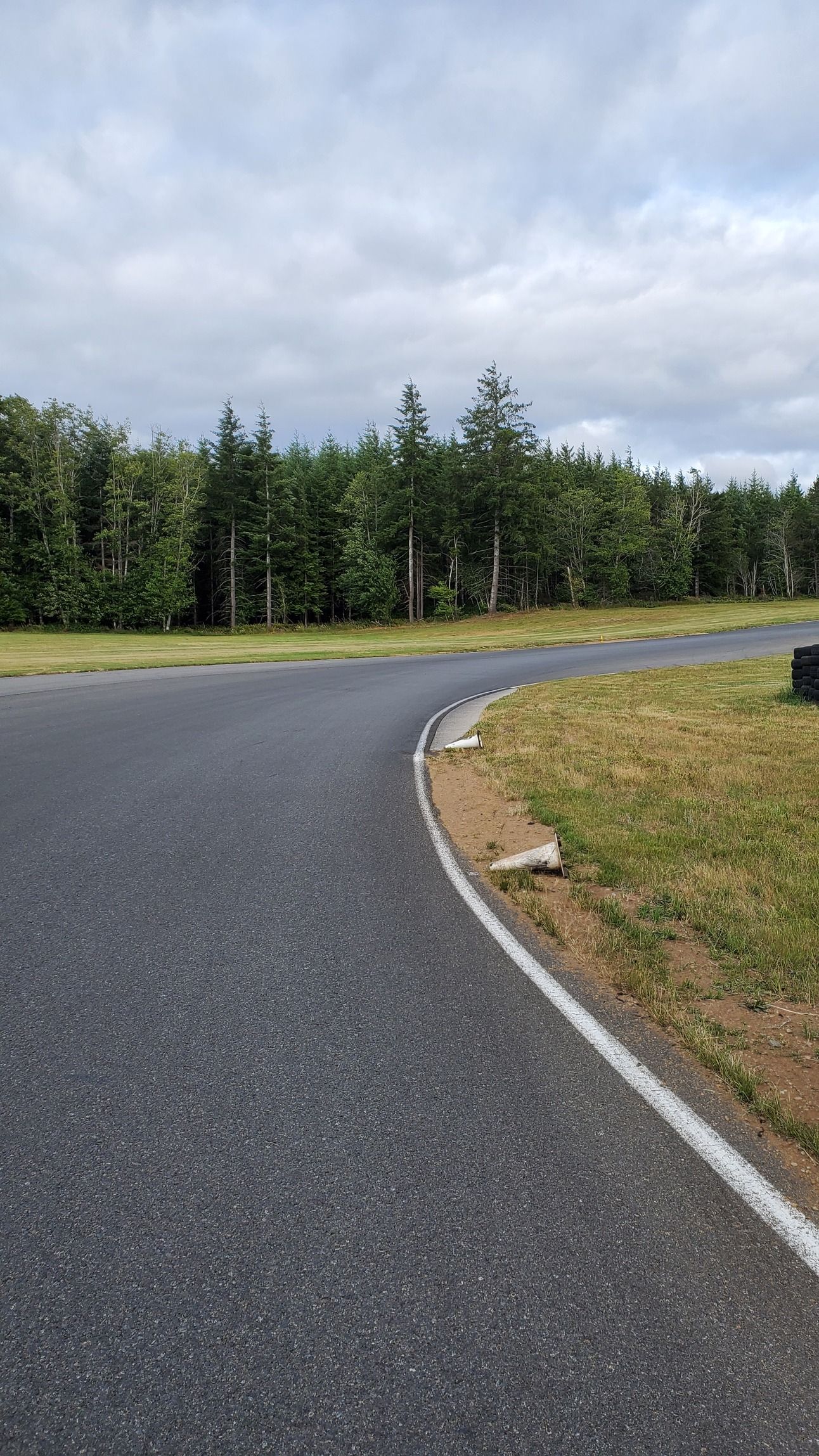
Looking backward from the Entry Apex at turn 5, at The Ridge. I took this picture back in 2020, before they had painted curbs.
Reply