- Pictures with Words
- Posts
- I can't hold my tongue anymore.
I can't hold my tongue anymore.
Can't? Or just plain, Won't...

Scott Clayton
September 30, 2024
I saw a bad pass on someone toward the end of the day, last track event. It was a bad pass, in a bad part of the track.
Bad Pass: Passing rules are, if two rider’s lines are coming together (converging), no passing is allowed. For example, once the slower rider ahead tips-in (turns-in) for the corner, the red area in the image below; no pass is allowed. This also applies to the exit of the corner. From the apex to the outer part of the track (Exit Point), no pass is allowed. If both rider’s lines are parallel or diverging, passing is allowed, the green area in the image below. Giving respect to the other rider’s comfort. No one may know the other rider’s comfort level on passing. So this is where courtesy comes in, give them plenty of room. If you find yourself in a situation where you think or know it was a bad pass. Raise your left arm and give them a wave, signaling that you realized that was a bad pass and you’re sorry about that. These rules are followed by Yamaha Champions Riding School (YCRS), Track Time (the track days I attend) and probably many other safety oriented organizations. Nick Ienatsch has a great article on passing. You don’t have to read this article to attend Track Time’s track day, they put out the same information at the Rider’s Meeting.

Image taken from “Ienatsch Tuseday” articles. Such good reads! Illustration by Robert Martin
Bad Part of the Track: Turn 3, of the crashes that I’ve seen, a good portion are at this corner. The racing line is tight through this area, due to the switch-back nature of turns 2-3-4 (left, right, left). The slower rider, just ahead of me, on a red Ducati had already tipped-in for turn 3, the passing rider dove underneath him. No wave.

It looked like a “Fuck You” pass, and when I talked to him in the pits after the session, his attitude matched his passing. I asked him, “Do you think that pass into turn 3 was a little sketchy?” He replied with a defensive, “NOPE!”
With such a confident and short answer, he knew exactly the situation I was referring to. “Did I? Make him crash? Or run him off track?”, he pointed out. And continued with saying there have been a lot of bad passes on him at this track. I said, ”We are not racing out here, we all have to go to work tomorrow.” He replied with, “It wasn’t a racing move.” I was shocked by his lack of concern for other riders on track. So I said, “So you are passing for YOUR comfort level?” In an insincere way he said, “I see what you’re getting at. Thanks for the feedback.” As if he just wanted me to shut up and go away. So, I did.
Just because you didn’t make someone crash or didn’t run them off the race track isn’t the only criteria for a good pass. Was this guy at the rider’s meeting? Does he even care?
Just because other people have done bad passes on you, doesn’t mean you should continue the tradition. The hero thinks, bad things have been done to me, but I will stop this from happening to other people, the villain thinks, bad things have happened to me so I will do bad things to everyone else. How are you riding with?
Maybe my approach could’ve been better. On my way over to talk to this guy, I was thinking about Dale Carnegie’s analogy on approaching people: Show up with a fist and you’ll have two fists right back at you. I knew I needed to approach him as calmly as possible, but also, this passing problem needed to be addressed right away or it will be swept under the rug. Next time, I think it would be best if I introduce myself first, then address the problem.
I won’t hold my tongue on bad passes anymore. Track days need to be an inviting place to ride, or else they will vanish.
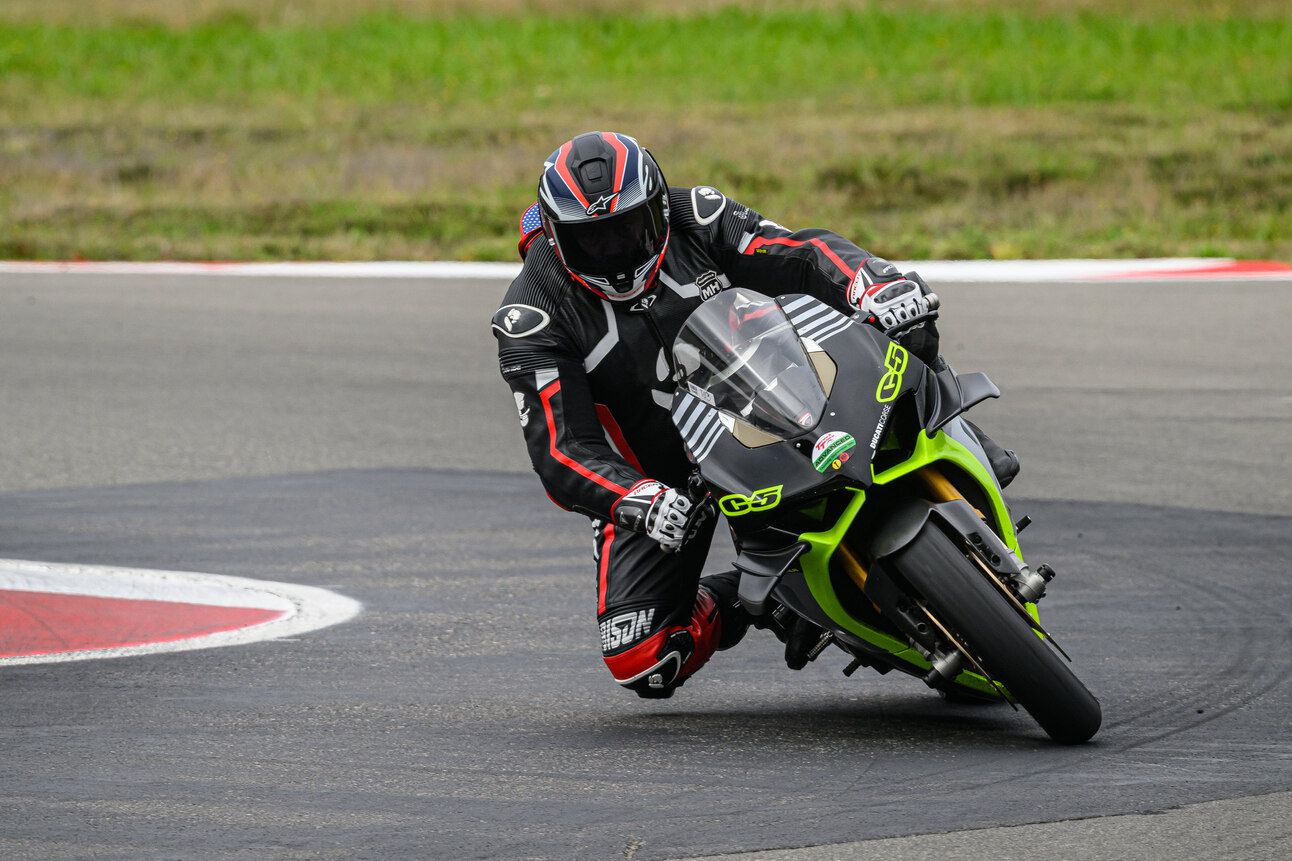
Photo by G. Powers Photography
Reply